What you are reading is narrative nonfiction. Every case examined in these pages has been drawn from public sources — court filings, media investigations, documented incidents. The author is not a participant in any of these events and has no access to sealed or private records.
Nothing in this book is intended as an allegation, a legal finding, or a moral verdict. Where the author draws conclusions, those conclusions concern patterns and systems — not the character or culpability of specific individuals. The goal throughout is analytical, not prosecutorial.
The Mediterranean at night goes black in a particular way — total and still, the kind of dark that makes a lit deck feel like the only real thing in the world. A man stands at the rail of a hundred-million-dollar hull with a glass in his hand, watching a coastline slide past. He could buy pieces of it if he wanted to.
He has built a distance so complete that by the time anything consequential reaches him, it has already been processed. Markets react. Advisers filter. Lawyers sand down the edges. Problems get absorbed several layers below him and arrive as bullet points.
Wealth does not announce danger. That is precisely the problem. It softens everything — sound, friction, consequence. The higher you go, the smoother the air feels.
This book begins where friction ends — in the quiet at the top, where insulation feels like safety, loyalty feels permanent, and scale feels like strength. From there, we descend.
In every era, societies construct a quiet belief about their most successful individuals: those who accumulate extraordinary wealth must also possess superior judgment, superior foresight, superior control over their own fate.
Recent years have tested that assumption in ways that are difficult to argue with.
Because wealth does not eliminate danger. It reorganizes it.
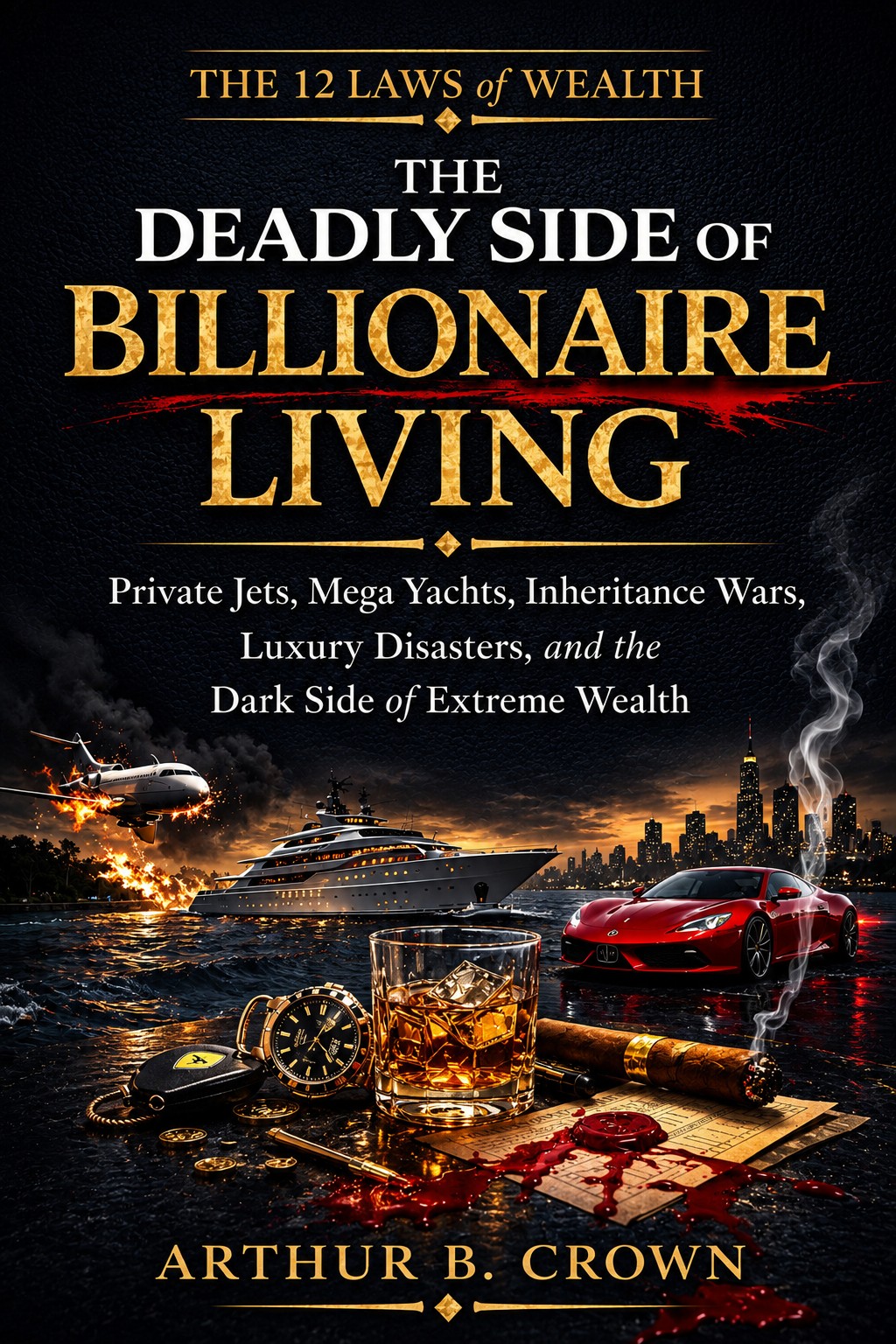
The Deadly Side of Billionaire Living is narrative nonfiction drawn entirely from public sources — court filings, media investigations, and documented incidents — examining what Arthur B. Crown calls the Wealth Exposure Sequence: the way extreme wealth relocates risk into environments most people never enter, from private aviation to remote estates to inheritance disputes.
The book draws on recent, publicly documented cases to argue that wealth doesn't eliminate danger — it reorganizes where that danger lives. It is explicitly analytical rather than accusatory: conclusions concern patterns and systems, not the character or culpability of specific individuals.
Readers of Arthur B. Crown's other work, and anyone interested in the structural, statistical side of how extreme wealth changes exposure to risk — presented as pattern analysis, not sensationalism.