This book started with a feeling — the one you get when you read about a case like John List or Jean-Claude Romand or Harold Shipman and find yourself arriving, past the horror, at a question that the horror tends to displace: how did no one know?
This book contains thirty-one cases from across six decades and eight countries. They were chosen to represent the range of what the double life looks like: the domestic parallel family and the institutional predator, the financial fraud and the sexual violence, the ordinary man with a company car and the colonel who commanded a military base. The range is the point. The mechanism is the same across all of them.
On the cognitive machinery of trust
Before the cases, a theory.
Human beings are not good at detecting deception in people they trust. We are systematically bad at it, in a direction, for reasons that are structural rather than correctable.
Always toward belief. When the people we trust tell us something, we tend to believe it. When we observe something inconsistent with what we have been told, we tend to find the interpretation of the observation that makes it consistent again.
These are not the ordinary people. They are the tail of the distribution — the cases where the cognitive shortcuts that are correct in the overwhelming majority of applications produce outcomes that are catastrophically wrong. Understanding this does not change what happened. It changes what we can honestly say about the people who were deceived.
The mechanism was not a failure of the people around them. It was a feature of those people — specifically, the feature of being people who trusted well.
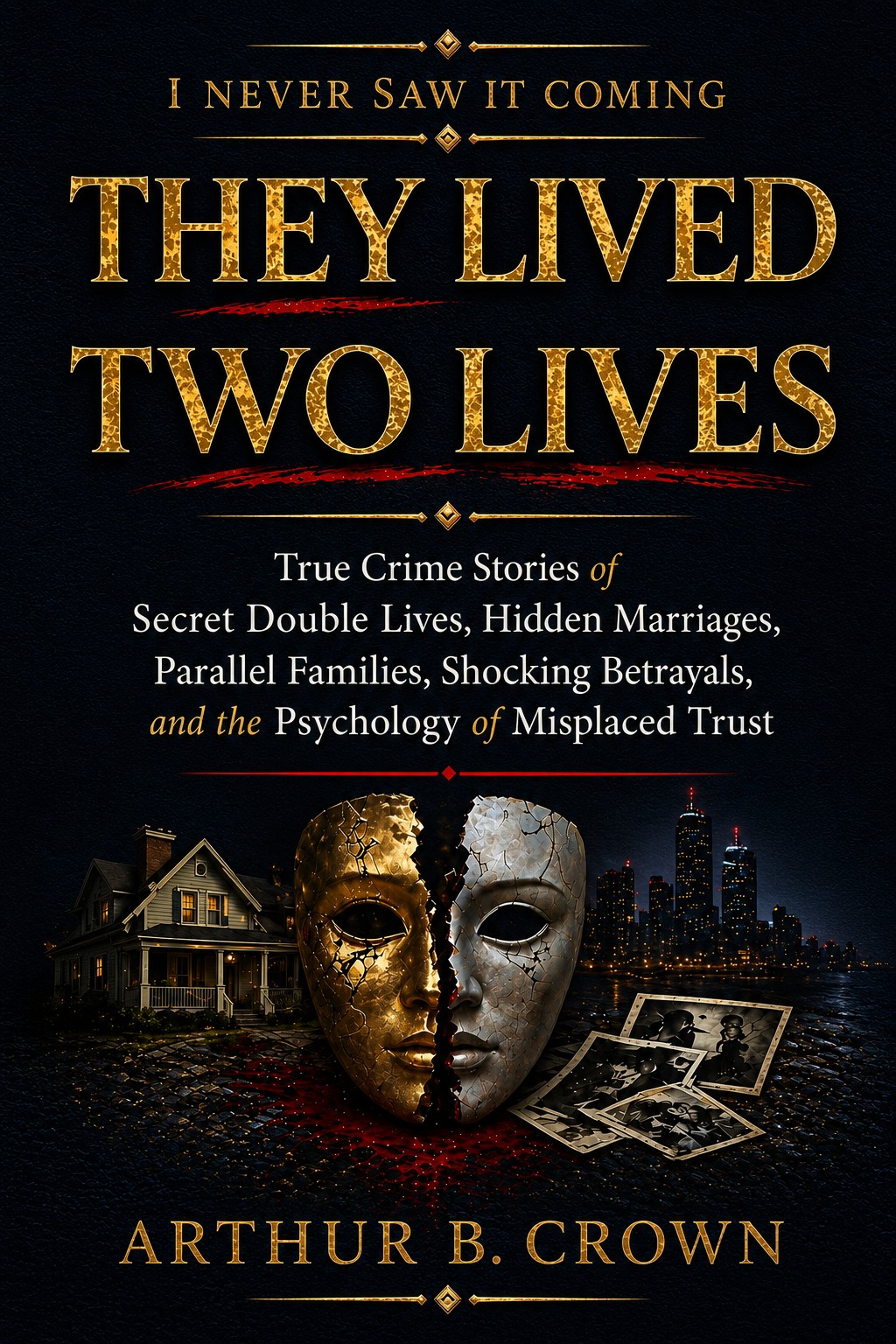
Part of the I Never Saw It Coming series, They Lived Two Lives examines thirty-one cases across six decades and eight countries of people who maintained secret double lives — parallel families, hidden marriages, and institutional double lives — sometimes for decades.
Arthur B. Crown looks past the drama of concealment to the actual mechanism: the cognitive shortcuts, the halo effect, and the trust capital that let these deceptions survive for years inside marriages, families, and institutions.
Readers of true crime and psychology who want to understand not just what happened in these cases, but the specific mechanics of how trust itself became the thing that made the concealment possible.