A fisherman found the body on the morning of April 30, 1943, bobbing in the swell off Huelva, on the Atlantic coast of Spain. It was wearing a British officer’s uniform and a life jacket, and a black briefcase was chained to the belt. Spain was officially neutral, which in practice meant that anything interesting washed up on its beaches found its way, sooner or later, to German intelligence. This did. Inside the briefcase were private letters between senior British commanders, chatty and gossipy, and buried in the gossip were hints that the Allies’ next landing in southern Europe would come in Greece and Sardinia. Sicily, everyone’s obvious guess, was to be the cover story.
Every word of it had been written in London. The dead man, “Major William Martin of the Royal Marines,” never existed; the body was that of a Welsh laborer named Glyndwr Michael, who had died alone and poor some months earlier. A small team of British intelligence officers under Ewen Montagu had dressed him, filled his pockets with theater stubs and love letters and an overdraft notice from his bank, and slipped him into the sea from a submarine. German reinforcements went to Greece. The Allies landed on Sicily in July.
I keep coming back to that operation, which its planners named Mincemeat, because nobody in it ever made an argument. Nobody tried to talk the Germans into anything. The British put an object where people were already looking and let those people find, all by themselves, the thing they half-expected to find. That’s the subject of this book. Not persuasion in the usual sense, with its speeches and its closing techniques, but the quieter work that gets done before anybody opens their mouth: the order of the rooms you walk through, the first number you hear, the person who was in the hallway before the meeting started.
If you would work any man, you must either know his nature and fashions, and so lead him; or his ends, and so persuade him; or his weakness and disadvantages, and so awe him; or those that have interest in him, and so govern him.
— Francis Bacon, “Of Negotiating,” 1597
Richard Russell of Georgia never married. In the late 1940s, when Lyndon Johnson came to the Senate as a freshman from Texas, Russell was the most respected man in the chamber, the leader of the Southern senators, a scholar of the rules, a man other senators went to when they wanted to know what the precedents allowed. He was also, by most accounts, alone a great deal. He spent long hours in his office, weekends included, and read the Congressional Record the way other men read the sports pages.
Johnson, who studied people the way a horse trader studies teeth, noticed. He asked for a seat on the Armed Services Committee, where Russell was the dominant figure. He started turning up at the Capitol on Saturdays and Sundays, when the building was nearly empty except for Russell. And he started inviting him home. Lady Bird cooked; there was Southern food and easy talk and, for a bachelor in his fifties, something like a family table on a Sunday. Johnson asked Russell’s advice and actually took it. Robert Caro, whose biography of Johnson I’m leaning on here, describes a relationship that came to look a good deal like a son’s toward a father.
Did Russell see what was happening? He was nobody’s fool. My guess is that he saw some of it and decided he didn’t mind, because the company was real even if the motive behind it was mixed. Either way, the results are on the record. In 1950 Johnson got the chairmanship of a new subcommittee on military preparedness, a plum for a junior senator, with Russell’s backing. In January 1953, with Russell’s support behind him, he became the leader of the Senate Democrats at forty-four, the youngest man ever to hold the job.
Here’s what strikes me about it. Johnson didn’t win Russell over by agreeing with him on the issues, or by being useful on votes, though he did some of both. He answered something Russell never would have said out loud.
People give reasons. They give them constantly, and the reasons are usually sincere enough. But the reason that gets said is built for company. It has to sound principled, and it has to let the speaker keep their dignity in front of whoever’s listening. Underneath it there’s often something blunter: I’m frightened of looking foolish; I want credit; I’m lonely; I can’t afford this; I promised my wife. Argue with the stated reason and you can win every point and lose the room, because the thing actually holding the person in place hasn’t been touched. Bacon, in the epigraph, was already making the same distinction four hundred years ago between a man’s stated ends and his nature, his weaknesses and the people who have a hold on him. Most of us only ever argue with the ends.
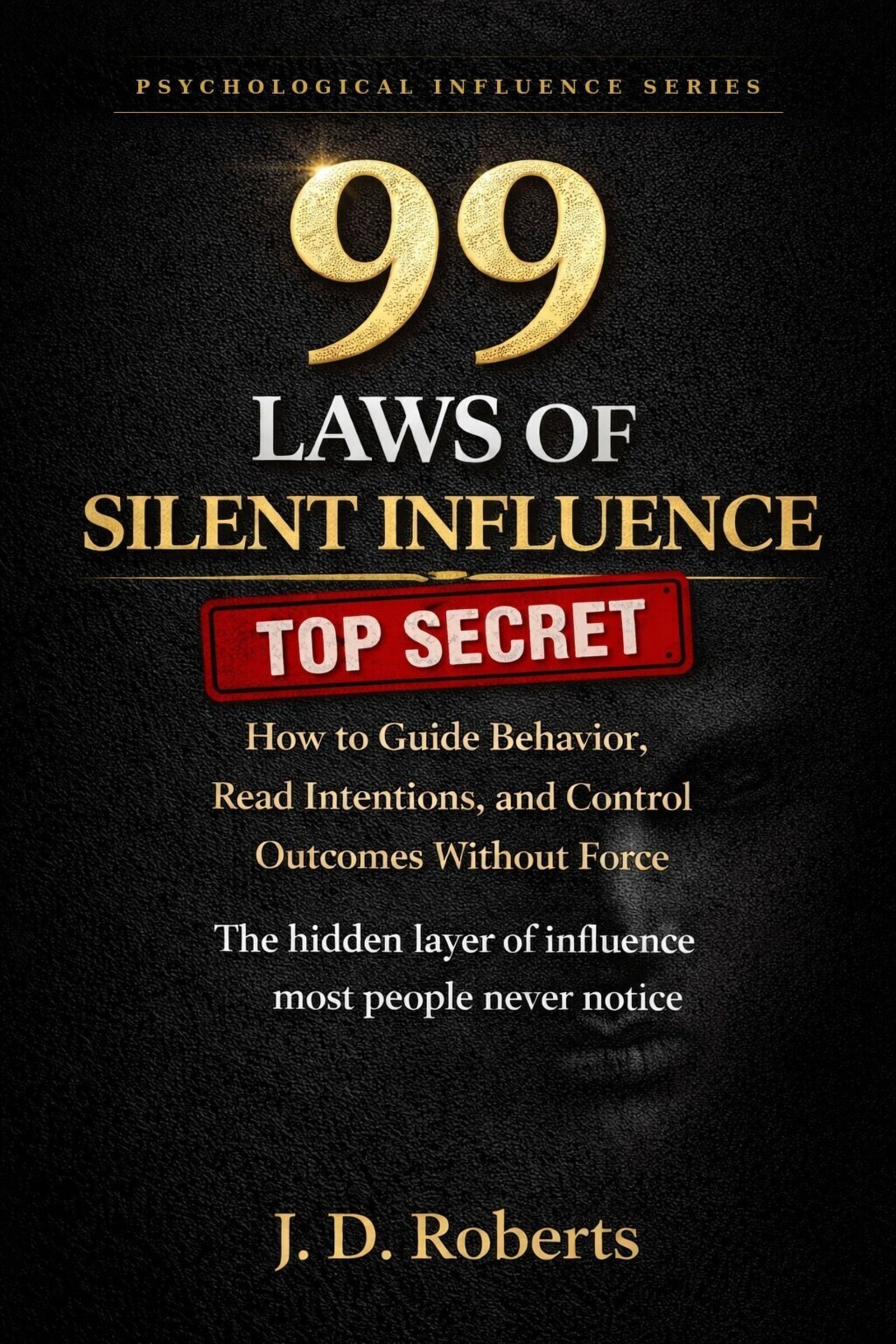
99 Laws of Silent Influence is about the work that happens before anyone opens their mouth — the order of the rooms you walk through, the first number you hear, who was in the hallway before the meeting started. J. D. Roberts deliberately skips the usual cast of Napoleon and the familiar courtiers, drawing instead on Ottoman palace corridors, a chimpanzee colony in a Dutch zoo, a Watergate security guard, and Operation Mincemeat's dead man washed up on a Spanish beach carrying fabricated secrets that fooled German intelligence.
Each of the ninety-nine laws ends with a section called The Counter — how to recognize the same method being used on you, and what to do about it. Organized in four parts moving from seeing to shaping perception to moving behavior to the long game, the book is built to be read twice: once as the operator, once as the mark.
Readers of J. D. Roberts' other psychology work who want the quieter, pre-verbal layer of influence named clearly — and a counter for each law, so the same methods are easier to spot when used on them.