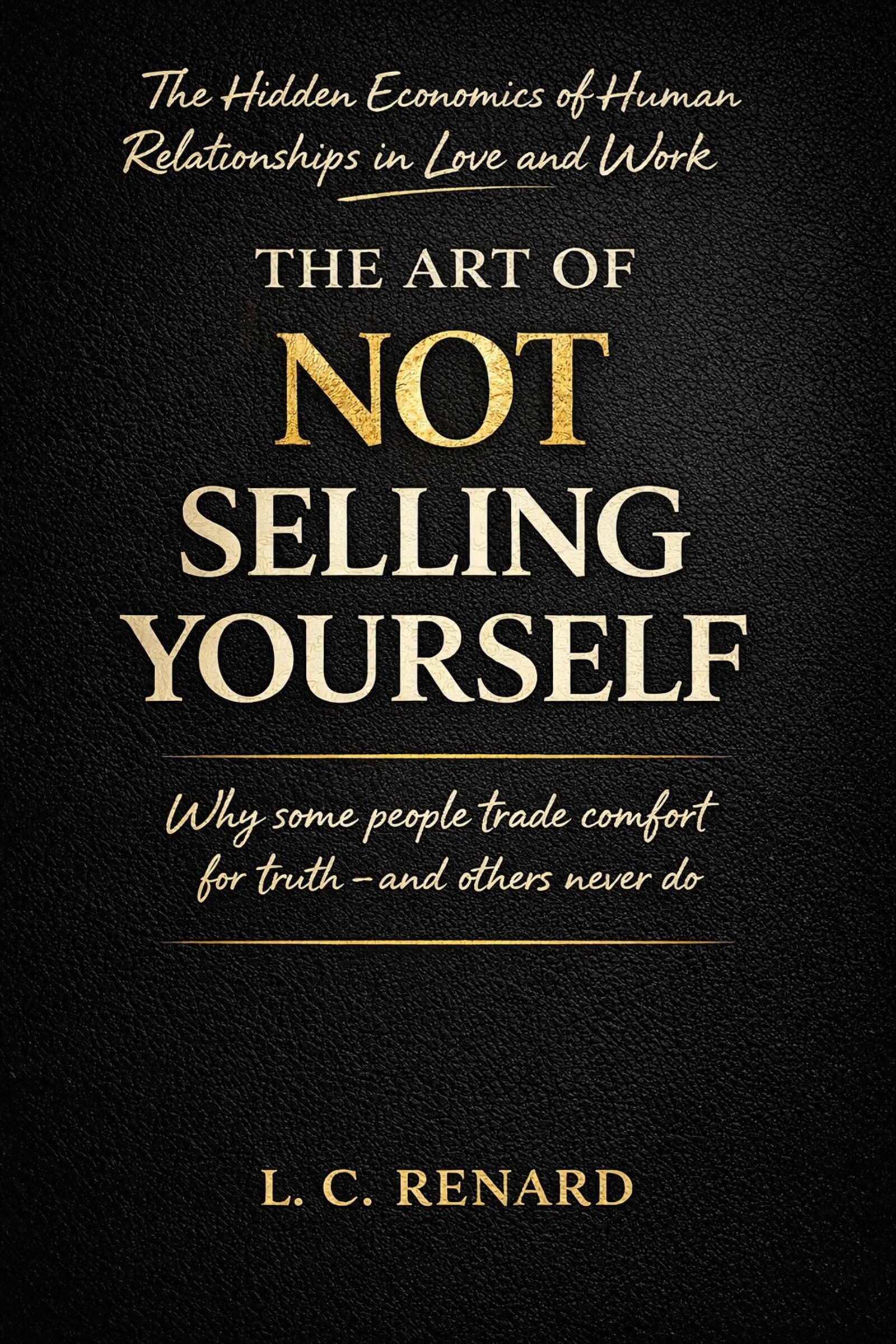
by L. C. Renard
You won't find advice in this book, or reassurance, or much in the way of moral instruction. I didn't write it to motivate anyone or to make anyone feel better. I wrote it to put names to things most people sense and rarely say out loud.
If you're hoping for validation, parts of it may sit uncomfortably with you. If you're after clarity, take it slowly.
We're raised on a tidy story in which love is pure, work means something, and success comes to whoever follows their passion. Yet when you look at how ordinary lives actually run, most of it is exchange. People trade time for money, affection for security, agreeableness for comfort, and silence for a place in the group. None of this means people are rotten. Any system with enough people in it and not enough of everything to go around ends up running on trades.
Plenty of people handle these trades without a scratch. They know the terms, bargain sensibly, leave when the deal changes, and never seem to mistake what they do for who they are.
Others attempt the same thing and come apart over years. They stay in relationships that photograph well and feel empty at night. They keep jobs that pay the rent and take something they can't name. They tell themselves the unease will pass, that gratitude will catch up, that love will show up once the conditions are right. Mostly it doesn't.
I think they're running on a different currency, and the exchange rate is brutal.
In 2024, a billionaire sports team owner said in an interview that his girlfriend — a woman more than forty years younger — had no idea who he was when they met. What drew her, he said, was his smile.
The internet took about an hour to turn it into a joke. The mockery was a little cruel, but what sat under it was simpler: almost nobody believed him. People just know, without needing it spelled out, that being attracted to someone and loving them are different things, and that money has a way of blurring the line for the person who has it.
I'm not writing to condemn that. People sell pieces of themselves all day long. I see no reason romance should be the one area exempt from economics. My objection is narrower. It's the pretending. Call a transaction love and it doesn't become love; it only becomes easier to live with.
I know because I tried it.
At twenty-two I came close to marrying a man twenty years older than me. I liked him. I respected him. I was grateful to him, and I told myself those were the grown-up versions of love and that the other kind would come later. It didn't come. What came instead was a kind of resistance I couldn't argue with.
I called off the wedding after the invitations had gone out. It cost me comfort and a great deal of approval, and it taught me that love is one of the few things you can't negotiate into existence.
The question worth asking isn't whether they like you. It's whether they would still pick you if the advantage disappeared tomorrow. Most people never ask, and a few don't need to, because they already know.
Most people choose comfort. A few choose truth. The Art of Not Selling Yourself examines the trades underneath ordinary life — affection for security, loyalty for a paycheck, silence for a place in the group — and the very different price two kinds of people pay for making them.
L. C. Renard writes without reassurance or moral instruction, naming what most people sense about love and work but rarely say out loud: that calling a transaction love doesn't make it love, it just makes it easier to live with.
Readers drawn to clear-eyed, unsentimental writing about relationships and self-respect — anyone who's suspected that a comfortable arrangement and a real connection are not the same thing, and wants the distinction named plainly.