I did not come to these ideas through a moment of dramatic awakening.
I came to them through failure — specifically, through the particular exhaustion that comes from doing everything right and watching results remain stubbornly absent. I had read the books. I had done the visualizations. I had repeated the affirmations, felt the gratitude, held the vision. I understood the framework well enough to explain it to others.
And yet something kept not working.
The question that eventually broke the pattern open was not "what am I doing wrong?" It was something quieter: what if the pushing itself is the problem?
What follows is not a new set of techniques. It is a clearer understanding of why the old ones work when they work, why they fail when they fail, and what the mechanics underneath the feeling of alignment actually are.
For a long time, science and spirituality spoke different languages.
Science focused on matter, measurement, and prediction. Spirituality spoke of meaning, awareness, and invisible forces shaping life. They were treated as opposites, and that separation had real consequences for both sides.
In recent years, respected scientists, physicists, and technologists have begun questioning one of the oldest assumptions of modern thought: that consciousness is produced by the brain. Among them is Federico Faggin, the inventor of the microprocessor. After decades spent shaping the digital age, he reached a conclusion that surprised even his peers: consciousness cannot be reduced to computation, data, or matter. It is fundamental.
This is not fringe thinking. A 2023 survey of philosophers of mind found that the majority now consider the question genuinely open — which would have been unthinkable even twenty years ago.
You are not here to force reality. You are here to cooperate with it intelligently.
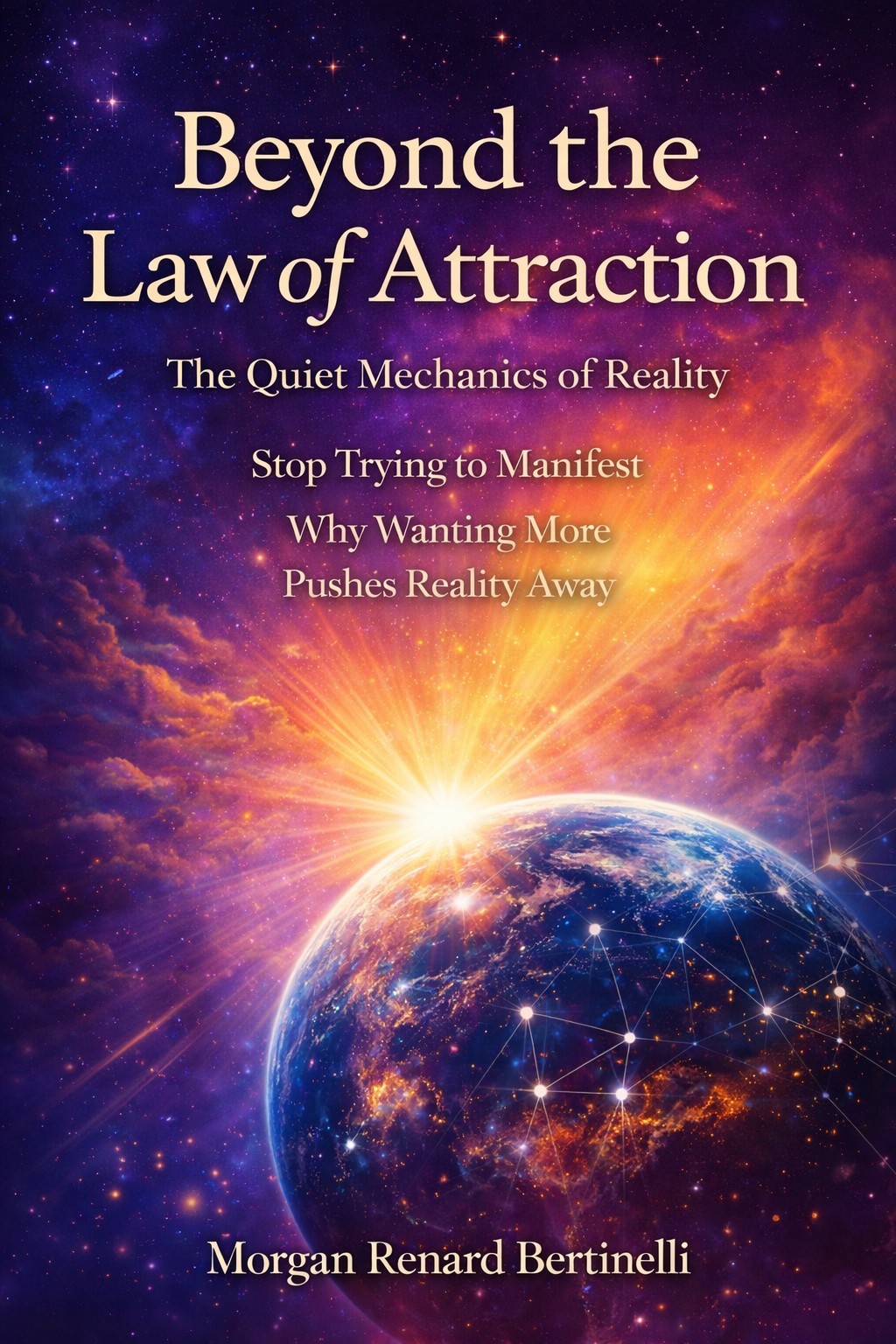
Beyond the Law of Attraction looks at why effort-based manifestation so often backfires, drawing on consciousness research, physics, and psychology rather than affirmations or mysticism.
Morgan Renard Bertinelli's central argument is that reality responds to alignment, not force — and that wanting something too intensely can itself become the obstacle. The book is not a new set of manifestation techniques, but an attempt to explain why the old ones work when they work, and why they fail when they fail.
Readers who've tried manifestation and law-of-attraction approaches without lasting results, and want a more grounded, less mystical explanation of why effort and obsession tend to push outcomes away.