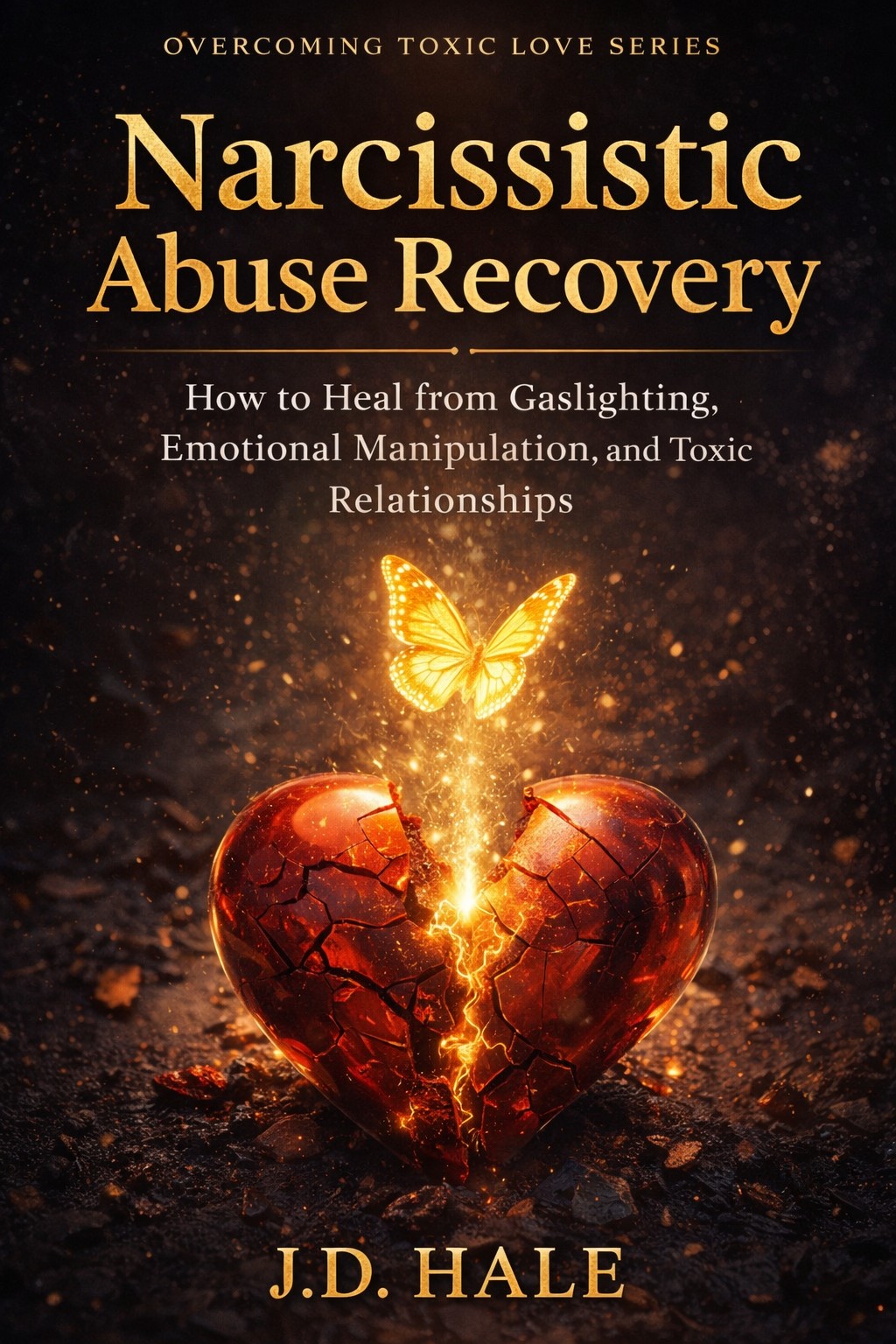
by J.D. Hale
I didn’t write this book from a safe distance. I wrote it from two different relationships, and I’m honestly still working my way out of the second one.
The first man I loved seriously was volatile. When he was angry he broke things: a lamp, a phone, once the bathroom door. Then, usually within a day, he would come back and own every bit of it. He cried, he apologized, he named exactly what he’d done. He couldn’t keep a lie going for longer than about twenty-four hours, and I believe the remorse was real. So was the damage. The cycle of blow-up, confession, repair and blow-up again wore me down until the exhaustion turned into a kind of grief. But I left that relationship, and with time and a good deal of help, I recovered from it.
The second relationship looked like the opposite in every way I cared about at the time. He never raised his voice. I can’t remember him ever saying a cruel word. He was calm and articulate and thoughtful, all the things the first one hadn’t been, and for a long while I thought I’d finally chosen well. I told my friends I’d learned something.
It took me years to understand what I was living in. There were no explosions to recover from and no tearful confessions. What there was, I eventually realized, was a man carefully presenting a person who didn’t exist, while the person who did exist, me, was being taken apart a little at a time. When it ended I had no bruises and no evidence. I couldn’t even tell a clear story. I had the strange, sick knowledge that I’d loved someone for years without ever actually knowing him. I don’t mean I’d loved a flawed or wounded version of him. I mean the version I loved had been made up.
The first relationship left marks I could point to. The second left me with questions I’m still carrying, and I want to be straight with you about that. This book doesn’t come from the far side of recovery. It comes from somewhere in the middle of it, from someone who has done the reading and the therapy and the 3 a.m. journaling and who still catches herself replaying old conversations, looking for the one sentence that would make it all make sense. That sentence doesn’t exist, and part of what this book is about is learning to stop looking for it.
After the first relationship, I found language everywhere. People understood what I’d been through, and there were names for it. After the second, I kept reaching for words and coming back empty-handed. So I wrote down the words I wish I’d had.
If you’ve ever tried to explain something that left no visible evidence, I wrote this for you. If you’ve wondered whether what happened to you counts, I think it does. And if you’re still in it, or out of it but not over it, or still unsure what “it” even was, you haven’t fallen behind anyone. This is where the book starts.
Before going any further, I owe you some honesty about this book’s limits.
Plenty of difficult relationships aren’t narcissistic abuse. A partner can be inconsistent, emotionally unavailable or self-centered without being a narcissist, and you can lose an argument without being gaslit. Some people who hurt us didn’t set out to.
Over the last ten years or so, the vocabulary of narcissistic abuse has spread so fast that it’s started to stretch. Words that once described specific clinical patterns now get applied to ordinary letdowns. That matters more than it might seem. If every hard relationship gets called abuse, the word stops carrying weight, and the people who really are living inside something destructive lose the precise language they need.
I can’t tell you whether your partner is a narcissist, and neither can any book. Narcissistic personality disorder is a clinical diagnosis that a trained professional makes after a structured assessment, and it can’t be made from the outside by the person on the receiving end. What I can do is describe patterns. Patterns are useful because they give people back confidence in what they saw, and that’s true whether or not anyone ever gets a label.
Hardly anyone walks into a controlling relationship because of force. They walk in because they’re fascinated.
If abuse showed up at the start looking like abuse, almost nobody would stay. People are wired to get away from danger. We aren’t wired to get away from meaning, or from the heady experience of feeling completely known by someone. That’s why the beginning never feels dangerous. It feels rare.
You talk until two in the morning. The coincidences keep piling up: the same books, the same odd opinions, the same small things you’d assumed only you ever noticed. You finish each other’s sentences. It doesn’t feel like chance. It feels like you’ve finally met the person who was supposed to find you.
What you don’t know yet is that this feeling can be produced. Sometimes it’s deliberate and sometimes it isn’t fully conscious, but some people have learned over years of practice how to create a sense of deep recognition. They know which questions to ask and in what order, how to hand your own words back to you, and when to reveal something vulnerable about themselves so it lands just as you’ve opened up. Nobody introduces themselves that way, of course. They introduce themselves as the person who finally gets you.
Narcissistic Abuse Recovery is part of the Overcoming Toxic Love series, focused specifically on covert manipulation and gaslighting — the kind of harm that leaves no visible evidence and is hardest to name.
J.D. Hale writes from direct experience alongside research, and is careful about the book's own limits: it offers patterns to recognize, not a diagnostic tool, and is explicit that not every difficult relationship is narcissistic abuse.
Readers who've sensed something was wrong in a relationship long before they could name it, especially where the harm was subtle rather than explosive, and are looking for language and validation rather than a diagnosis.