She had treated him as per every single rule in the book in a way it should have been done.
She was understanding when he needed space and gave it to him, she was even patient when he went quiet. She always supported him when he had issues at work and she never mentioned marriage or asked him where things were going. She was forgiving, created no drama, and always communicated clearly. She was the ideal partner any man would dream about.
One Saturday afternoon, he told her he didn't think things were working between them.
She felt crushed. What had she done wrong? She couldn't identify a single thing. She'd been generous with him, emotionally available, steady when things got hard — everything the advice always says to be. She had, in short, tried very hard.
That was the problem — though it would take her months to understand it.
Effort, in the way most of us have been taught to offer it, doesn't build attraction. It often quietly dismantles it. Not because the effort isn't genuine, and not because the woman offering it isn't worthy. But because attraction doesn't follow the rules we're given. It follows different ones — less logical, more counterintuitive, and once understood, far more workable.
That is what this book is about.
Most women who struggle in love are not doing anything wrong in any moral sense. They are doing exactly what they were taught: communicating openly, giving generously, making themselves available, trying to demonstrate that they are worth staying for. The problem is that attraction does not respond to what is right. It responds to what is rare.
The chapters ahead are not about manipulation. They are not about pretending to feel less than you feel, or timing your messages, or performing an indifference you don't have. They are about understanding — really understanding — how desire, attachment, and commitment actually form in men, so that you stop working against yourself without knowing it.
Picture two women at the same birthday party in London, both meeting the same man on the same evening.
The first is warm and funny and immediately at ease. She laughs at his jokes, asks about details about his life and work with curiosity, shares a bit about herself. When the evening ends and he hasn't asked for her number, she doesn't engineer a moment to change that. She says goodnight and means it. She has a life to go back to.
The second woman is equally warm, equally attractive, and has been hoping to meet someone for a while — which shows in ways she hasn't noticed. In how carefully she listens for signs of his interest. In how quickly she fills silences, how much she offers about herself in the first hour.
Both are good people, who are interested in him. Yet one is easy to think about the next day, and the other leaves him with a sense of having been slightly on the hook.
The difference between them has nothing to do with attractiveness or social skill or emotional intelligence. It has to do with what each woman's behavior communicates about how much she needs the interaction to go a particular way.
The truth is that a good woman is not the same as a desired woman.
Attraction is not a moral system. It doesn't distribute itself according to goodness or effort or deservingness. It responds to dynamics — to the emotional charge between two people, to the sense that something is possible but not yet certain, to a quality of presence that suggests the person has enough going on in their own life that this interaction is a genuine pleasure rather than a necessary outcome.
A man doesn't fall in love because a woman proves her value. He falls in love because he discovers it himself. And discovery requires space, uncertainty, and enough time for the thing to feel like his own.
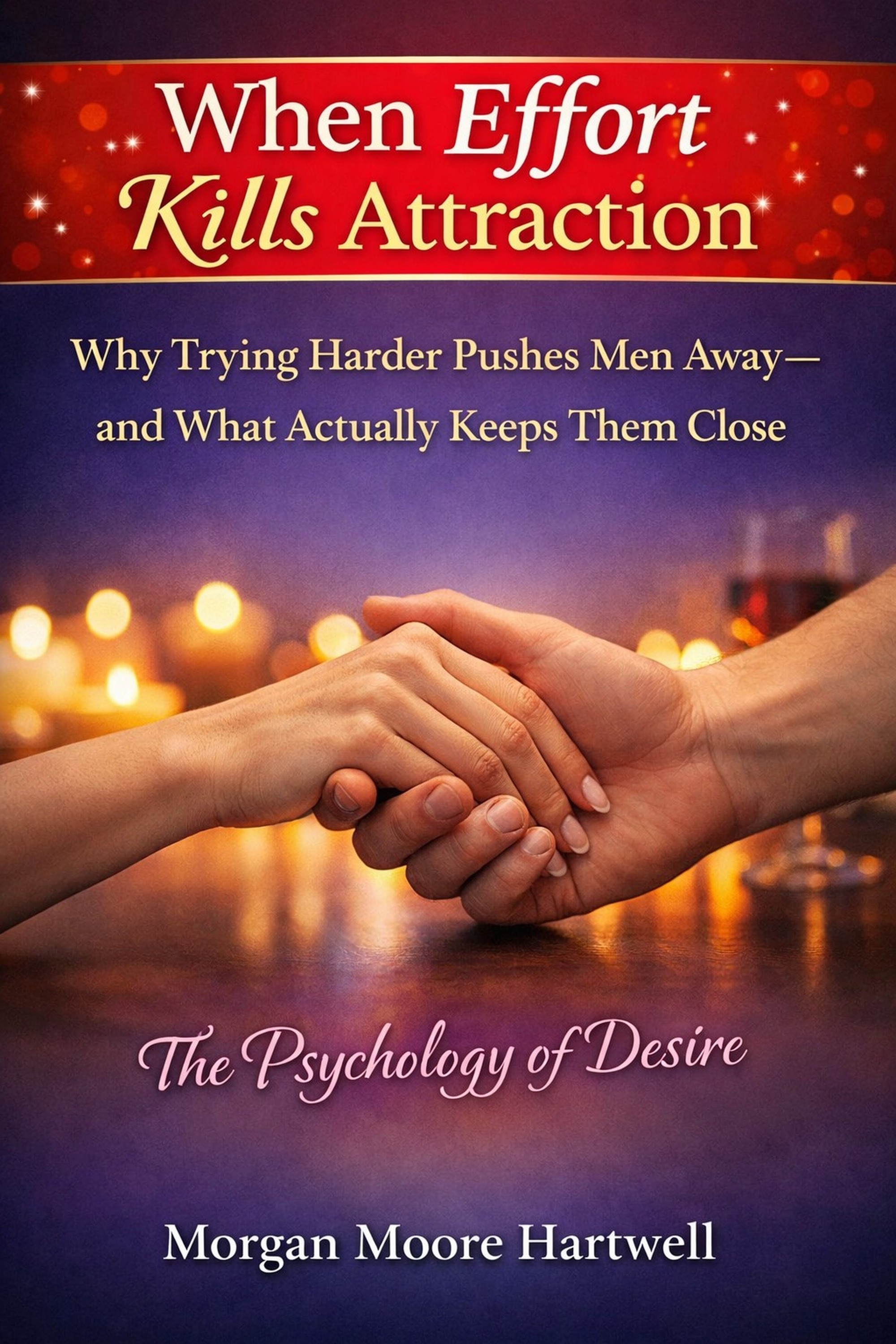
Why does trying harder so often push people away? When Effort Kills Attraction looks at the psychology behind desire, scarcity, and effort — and why the instinct to chase, prove, and over-give usually backfires.
Drawing on research in relationship psychology, Morgan Moore Hartwell breaks down what actually keeps people close: not more effort, but the right kind of presence.
Anyone who's wondered why the harder they tried, the further someone drifted — and wants a grounded, practical answer instead of another dating cliché.