I’m not going to try to convince you of anything in this book. I’m not diagnosing anyone, and I’m not building a case against a particular man, although you’ll meet one. If you were hoping for a clean villain, you may find parts of this frustrating. What I can give you is an honest account of how my own sense of what was real got bent out of shape, and how it slowly came back.
You might recognize a single scene long before you recognize the whole pattern. That’s fine. You don’t have to agree with every line or see yourself on every page, and you certainly don’t need to make any decisions while you’re reading.
Read it at whatever speed you like. If a page stings, let it. If something makes you exhale for the first time in a while, notice that too.
Apart from me, the people quoted here are composites put together from many conversations. I’ve changed names and details.
Before the notes on my phone, before the night I sat up until three rebuilding a timeline on the back of an envelope, there was a stretch when I was simply happy.
He was good at the beginning. I want to say that clearly, because once the rest of the story is known it’s tempting to go back and paint the early weeks black, as if every kind word had been bait. I don’t think that’s true, and I don’t think it helps anyone.
What I remember is how closely he listened. I’d mention a novel I’d been meaning to read, or a little town upstate I’d always wanted to visit, and three weeks later he’d bring it up as if he’d written it down. Maybe he had. At the time it felt like being known. Later it felt more like being catalogued. But I didn’t see the difference then.
He was funny, quick to laugh, easy in his own skin in a way I’d always envied in other people. He was the kind of person who walks into a crowded party and the room seems to warm up by a degree or two. Around him I felt bigger, more like myself, or what I imagined was myself. Much later I’d read that people who are skilled at steering others often start by making them feel expanded, because people who feel expanded are easier to lead. I’m not sure he knew he was doing it. I certainly didn’t.
When I started talking to other people who’d been through something like this, I was struck by how similar our beginnings sounded. Leigh, a teacher in her late thirties, said: “He made me feel like I was finally allowed to take up space. The things I thought were too much about me, he treated like the best parts. I’d never had that. I didn’t find out until later that he’d made at least three other women feel exactly the same, in the same words, in the same order.” Marcus, an architect in his forties, said: “She didn’t lie to me at first. She was warm and curious and genuinely there. The lies came later. But I’d already decided who she was based on those first months, so every time something didn’t fit, I treated the new version as the mistake. I had it backwards.”
That’s what makes it so hard to name later. The warmth wasn’t fake, exactly. It just wasn’t attached to anything solid underneath. It lived on the surface, and the surface was all I was shown.
I wasn’t stupid to fall for it. I was working with partial information, which is how everybody starts everything. What I couldn’t have known was that the same qualities that drew me in would later be used against me. The confidence that felt like safety would turn into the confidence with which he told me I was wrong. The attention would start to feel like being watched. His memory for my small details would turn out to be very selective about the big ones.
None of that was visible then. There was a man who made the air feel different and who looked at me as if I were worth looking at. I remember thinking I’d been lucky. In a way I had. I just didn’t know yet what kind of luck it was.
For several years I was involved with a pathological liar. I didn’t know that was what he was until it was over.
At the time I’d have called him dramatic. A bit much with words. The sort of man who couldn’t tell a story without making it slightly bigger than it was. He lied when there was no reason to lie, and that was the first thing I missed.
One Christmas he gave me a piece of jewelry from a designer shop on Madison Avenue. It was lovely. When I thanked him, he said, with a little smile that looked practiced, “You’re the only person I bought a present for this year. I didn’t even get anything for my daughter.” He said it like it was part of the gift. And I’ll be honest, it worked. I felt chosen. It was an odd thing to say about your own child, and a small voice in me noted that, but I didn’t think it was a lie. People exaggerate their feelings all the time.
Months later I found out he’d bought three presents that Christmas, all from the same shop, all much alike. I’d been given one of them. The lie got him nothing. It protected him from nothing. That should have told me something.
He was English, from London, and charming in the way people mean when they can’t quite say what else someone is. The charm papered over things. Whenever a detail seemed slightly off, his confidence would roll right over it, and I’d let it.
I thought he just had a bad memory. He’d tell a story one way and then, months later, tell it differently. “Didn’t you say that happened in Milan?” I’d ask. “No, Paris,” he’d say, without missing a beat. “I’ve never even been to Milan with her.” With her, or him, or them; the people in his stories changed, the places moved around, and every version came out with the same calm certainty. Enough time always passed between tellings that I’d doubt myself before I doubted him.
I’d never met anyone who lied like that. I’d known people who lied to get out of trouble, or to impress someone, or to dodge embarrassment. I understood those lies. His didn’t fit. They didn’t protect him. Half the time they made his life harder, creating contradictions that never needed to exist. I kept looking for the motive, as if I were reading a mystery novel, and the motive never turned up.
Later I learned the lies weren’t limited to stories. He’d lied about the main facts of his life. He had a second child. He was married. And every single time I saw him, he found a way to mention how single he was. Not defensively. Breezily. As though saying it often enough might make it so.
People find this part hard to believe. Surely there were signs. Surely the truth was right there and I chose not to look. But this kind of lying doesn’t feel like being deceived. It feels like the weather. It’s like living in a room where the thermostat keeps changing by a degree or two, and you assume you’re the one who’s run hot or cold. Plenty of his lies weren’t even dramatic. They were decoration, sprinkled into conversation like salt into a dish that didn’t need it.
It’s only recently that psychologists have started studying pathological lying as a condition of its own. In 2020 two researchers, Drew Curtis and Christian Hart, proposed a working definition: a persistent, pervasive and often compulsive pattern of excessive lying, lasting for months, that causes real distress or impairment and can put the liar or others at risk. In their surveys, a minority of people described lying far more often than everyone else, often with no clear goal, and many said they felt unable to stop. I knew none of that then. I didn’t know lying could be a habit rather than a strategy, or that the plain truth could feel threatening to someone even when it cost him nothing. I thought I was getting to know a complicated man. What I was actually doing was learning, a little at a time, not to trust my own eyes.
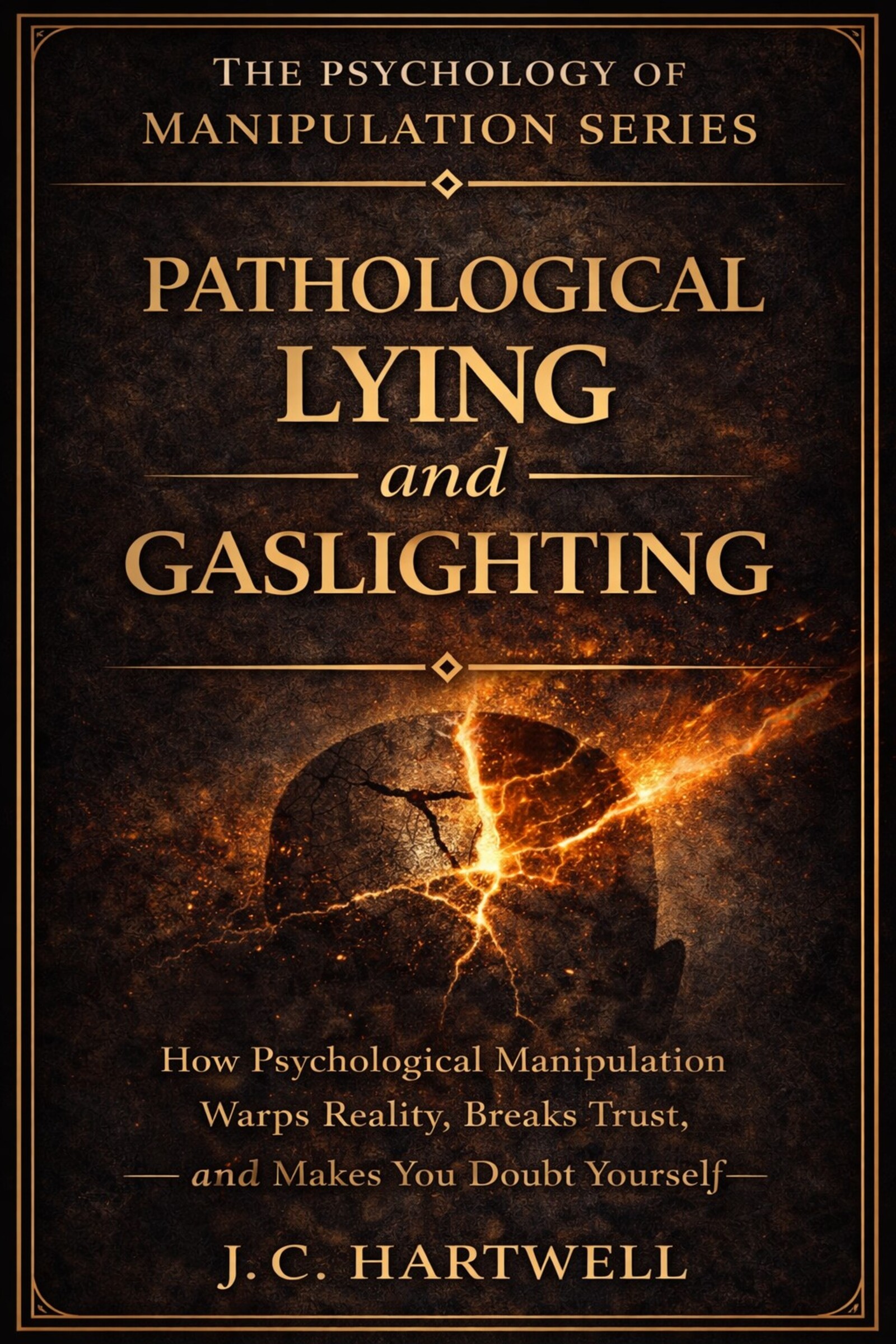
Pathological Lying and Gaslighting is a first-person account of a relationship with a man whose lying had no discernible motive — lies that protected him from nothing and cost him nothing, told with the same calm certainty every time. J.C. Hartwell traces how that pattern slowly turned into something else: a negotiation over what was even real, conducted one small, reasonable-sounding conversation at a time.
Part of the Psychology of Manipulation series, the book moves from the early charm through the slow erosion of certainty to the eventual return of trust in one's own perception — with composite accounts from others who lived through the same pattern alongside the author's own.
Readers who've loved someone whose stories never quite held together, and who want language for the particular, disorienting experience of being lied to by someone with nothing to gain from it.