Your skin started looking different a few years ago. Maybe it was the lines around your eyes. The way your cheeks seem to have shifted slightly — less lifted, less firm. You told yourself it was stress, or sleep deprivation, or simply the passage of time.
Then your joints started talking. A click in the knee when you stand up. Stiffness in the morning that takes an hour to shake off.
And somewhere in the background, your gut has been keeping its own record. Bloating that appears out of nowhere. Digestion that feels sluggish.
Here is what no one has told you: these aren't three separate stories. They are the same story, told by the same system — and that system is collagen.
Collagen is the most abundant protein in the human body. It forms the scaffolding of your skin, the cushioning in your joints, the lining of your gut, the walls of your blood vessels, and the structure of your bones.
Most people treat these as separate conditions. They see a dermatologist for their skin, an orthopedist for their joints, and a gastroenterologist for their gut — never addressing the underlying architecture that all three share.
This book is about addressing the architecture.
Think of your body as a building. The cells are the rooms, the organs are the floors, and the systems — circulatory, digestive, musculoskeletal — are the infrastructure. Collagen is the steel framework holding all of it upright.
More precisely, collagen is a family of proteins — there are at least 28 types identified in the human body, though Types I, II, and III account for the vast majority of our structural needs.
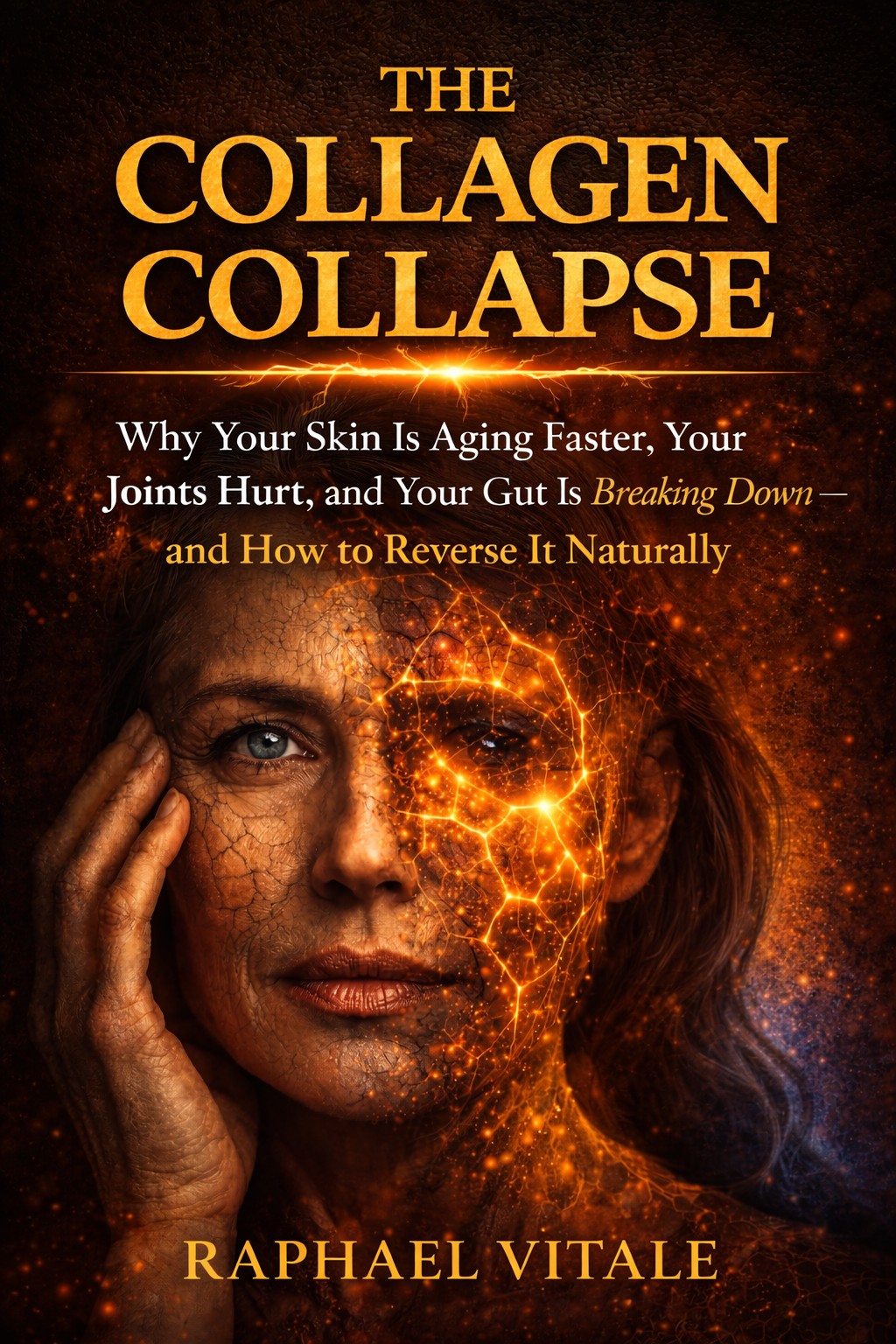
The Collagen Collapse looks at collagen's role as the connective tissue running through skin, joints, and gut lining — and makes the case that skin changes, joint stiffness, and digestive discomfort are often related symptoms of the same underlying decline, rather than three unrelated conditions.
Raphael Vitale walks through what collagen actually does in the body, why production slows with age, and which everyday factors influence that decline — along with a look at where common collagen supplements fall short of what they promise.
Readers interested in the connective-tissue science behind skin, joint, and gut health, looking for an explanatory starting point rather than a specific treatment plan. As with any health-related reading, consult a healthcare provider before making dietary or supplement changes.