This book started as a conversation I kept having.
A friend would describe, in careful and slightly embarrassed detail, her relationship with food — the diets that worked and then didn't, the hunger that never quite resolved. She'd finish the description the same way every time: "I know what I should be doing. I just don't do it. I don't know what's wrong with me."
What struck me, as these conversations accumulated, was not the suffering — though the suffering was real. It was the explanation everyone had accepted for it. The universal, unquestioned conclusion that the problem was them.
Nothing. The explanation is wrong. That is what this book is about.
I want to be clear about what this book is, and what it is not.
This is not a diet book. It does not contain meal plans, calorie targets, macronutrient ratios, or a thirty-day challenge with a motivational send-off at the end. There is no list of foods you should eat and no list of foods you should avoid.
What this book contains is something I believe is more valuable than any of those things: an explanation. A real one.
Imagine being given a map to navigate an unfamiliar city, and the map is wrong. Not slightly wrong — wrong at a fundamental level, organized around a geography that does not correspond to where you actually are. You follow the map faithfully. You take the turns it indicates. And you end up, every time, somewhere other than where you intended to go.
The map most people have been given about eating goes like this: food intake is governed by choice; choice is governed by willpower; willpower is a matter of character. This map is wrong. It does not correspond to the territory of how human eating actually works.
This book is a different map.
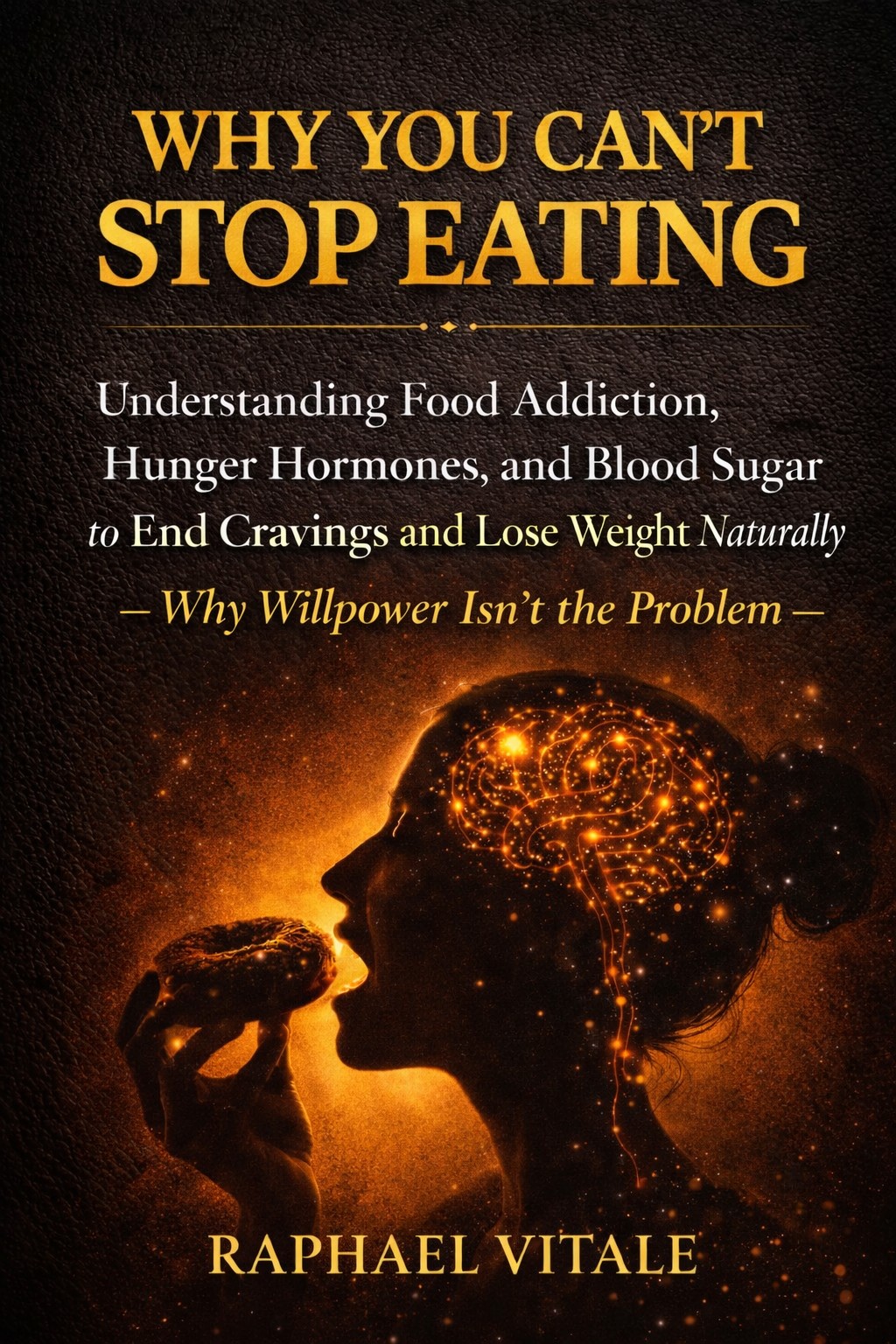
Why You Can't Stop Eating is not a diet book — there are no meal plans, calorie targets, or lists of foods to eat or avoid. Instead, Raphael Vitale explains the biological systems behind hunger, cravings, and appetite: the hormones, sleep, and stress factors that shape eating behavior largely beneath conscious awareness.
The book's central argument is that eating difficulty is rarely a matter of willpower — it's what happens when a biological system built to regulate hunger reliably gets disrupted by modern conditions it wasn't designed to handle.
Readers who've tried repeated diets without lasting results and want to understand the biology behind why restriction so often fails, rather than another program to follow.