This book started with a conversation I couldn’t stop thinking about.
A woman in her late forties, whom I’ll call Ruth, told me about leaving a marriage of twenty years without being able to point to a single reason. There was no affair and no blow-up. Something had built up over the years, and she only found words for it long afterward. “It felt,” she said, “like being paid for years in a currency I couldn’t spend.”
Her husband had been generous with his time, his attention, his money and the security he provided. She’d received all of it, and she’d never found a way of giving back that felt real to either of them. Her gratitude was sincere but incomplete, and the love between them was real but lopsided. She stayed long after the arrangement stopped working, because neither of them had any language for what the arrangement actually was.
I’ve heard versions of Ruth’s story many times since. The details change, but the outline is remarkably consistent. One person gives more than can be returned, or the other receives more than she can hold. The exchange runs for years without anyone naming it, and when it finally collapses, neither person quite knows what they’re grieving.
This book is my attempt to name it. What I call invisible debt isn’t a moral judgment, and it doesn’t require anyone to behave badly. It’s what happens when giving and receiving go unacknowledged for long enough that they start to carry weight. It shows up in marriages, workplaces, friendships and families, and in the private bookkeeping of a single life. All it needs is for two people to keep pretending that something doesn’t cost what it costs.
I’ve been on both sides of it. I’ve given in ways that looked generous and worked as a kind of control, and I’ve received in ways that looked grateful and amounted to taking. Most of what’s in these pages I learned the slow way, by watching patterns repeat in my own life and in the lives of people I knew well, until I could finally see how they worked.
Where I draw on research, I’ve tried to describe it accurately and not stretch it. The people in the stories are composites, with names and details changed, apart from public figures whose stories are on the record.
You won’t agree with everything here, and that’s fine. I’d only ask that you read slowly enough to notice where you push back. In my experience, that’s often exactly where the debt is.
Nobody remembers signing it. There was no ceremony and no moment of conscious agreement, and yet a great many lives run on the same unspoken terms: take what’s offered, don’t ask what it costs, and hope the bill never arrives.
Nobody enforces this contract, and you don’t have to believe in it for it to operate. It’s taught sideways, through praise and stories and the way families work, and most of us absorb it before we’re old enough to examine it. Its clauses go something like this. If something feels good now, you can ignore what it costs later. If nobody asks for repayment, nothing is owed. If the loss comes late, it doesn’t count.
Plenty of sensible, intelligent people live by these terms without ever noticing them, and then wonder why their lives feel unsteady. They’re told to receive endlessly and give selectively, to want without measuring and to take without finishing. Then a relationship cools for no obvious reason, or money comes in and quietly drains away, or a success they worked toward feels strangely weightless once they have it.
I want to be careful here, because books like this one have a habit of promising that every misfortune has a hidden cause the reader could have controlled. That isn’t true, and I don’t believe it. Plenty of loss is simply bad luck. Illness, accidents and recessions don’t check anyone’s moral ledger. What I’m describing is narrower and, I think, more useful: a set of patterns in how people give and receive that tend to produce predictable kinds of trouble, and that can be noticed and changed.
None of this is new. Long before anyone wrote self-help books, anthropologists and sociologists had noticed how much of human life runs on exchange that nobody writes down. In 1925 the French scholar Marcel Mauss published a long essay called The Gift, drawing on accounts of societies from Polynesia to the Pacific Northwest. His central observation was that gifts are almost never free. In every society he studied, receiving a gift created an obligation, and the obligations came in three parts: to give, to receive and to give back. Refuse any of the three, and the relationship suffered. Thirty-five years later, the American sociologist Alvin Gouldner described what he called the norm of reciprocity, the expectation, found in some form in nearly every culture ever studied, that people should help those who have helped them and not harm them.
Most of us know this instinctively. We’ve all felt the faint discomfort of being given something we can’t repay, or the heaviness of a friendship that began warmly and ended in a silence neither person could explain. These aren’t failures of character. They’re what happens to exchange that never gets tracked.
The idea that you can receive something without any cost is one of the most successful illusions people have ever sold each other. It survives because it’s convenient. Free feels light and lucky, like proof that the world has finally decided to be kind.
Most of the time, free is really a delay. Free help, free love, free money, free opportunities: the language changes, but somewhere in the back of the mind sits the assumption that if no bill arrives straight away, none ever will. That assumption causes a surprising amount of damage.
I’m not saying anything mystical here. When something comes into a life, it usually brings something with it, whether that’s an expectation, a change in a relationship, or a responsibility nobody mentioned. The trouble isn’t that people take. Everyone takes; it’s how we survive. The trouble is that most of us don’t notice what we’ve taken until it starts taking from us.
Part of what makes this hard to see is timing. The cost rarely shows up where the gain did. It moves around and waits and changes shape. A gift turns up later as a vague sense of obligation, help turns into resentment, and a stroke of luck slowly erodes your confidence that you earned anything. By the time you feel the weight, you’ve forgotten when you picked it up.
Modern life is very good at hiding the price tag. Free trials promise access without commitment. Apps cost nothing because, as the saying goes, you’re the product. Workplaces talk about family while expecting unpaid evenings. Even gratitude has turned into a performance, a quick “thanks so much!” typed and sent before the thing has really registered.
Social psychologists have shown how strongly even tiny favors pull at us. In a well-known experiment in 1971, the psychologist Dennis Regan had participants rate paintings alongside a young man named Joe, who was actually working with the researchers. During a break, Joe left the room and, in some sessions, came back with two bottles of Coca-Cola, one for himself and one for the participant. Later, Joe asked the participant to buy some raffle tickets. People who’d been given the unrequested Coke bought about twice as many tickets as people who hadn’t, and it barely mattered whether they liked Joe. A ten-cent soda created an obligation that outweighed their feelings about the man who’d given it.
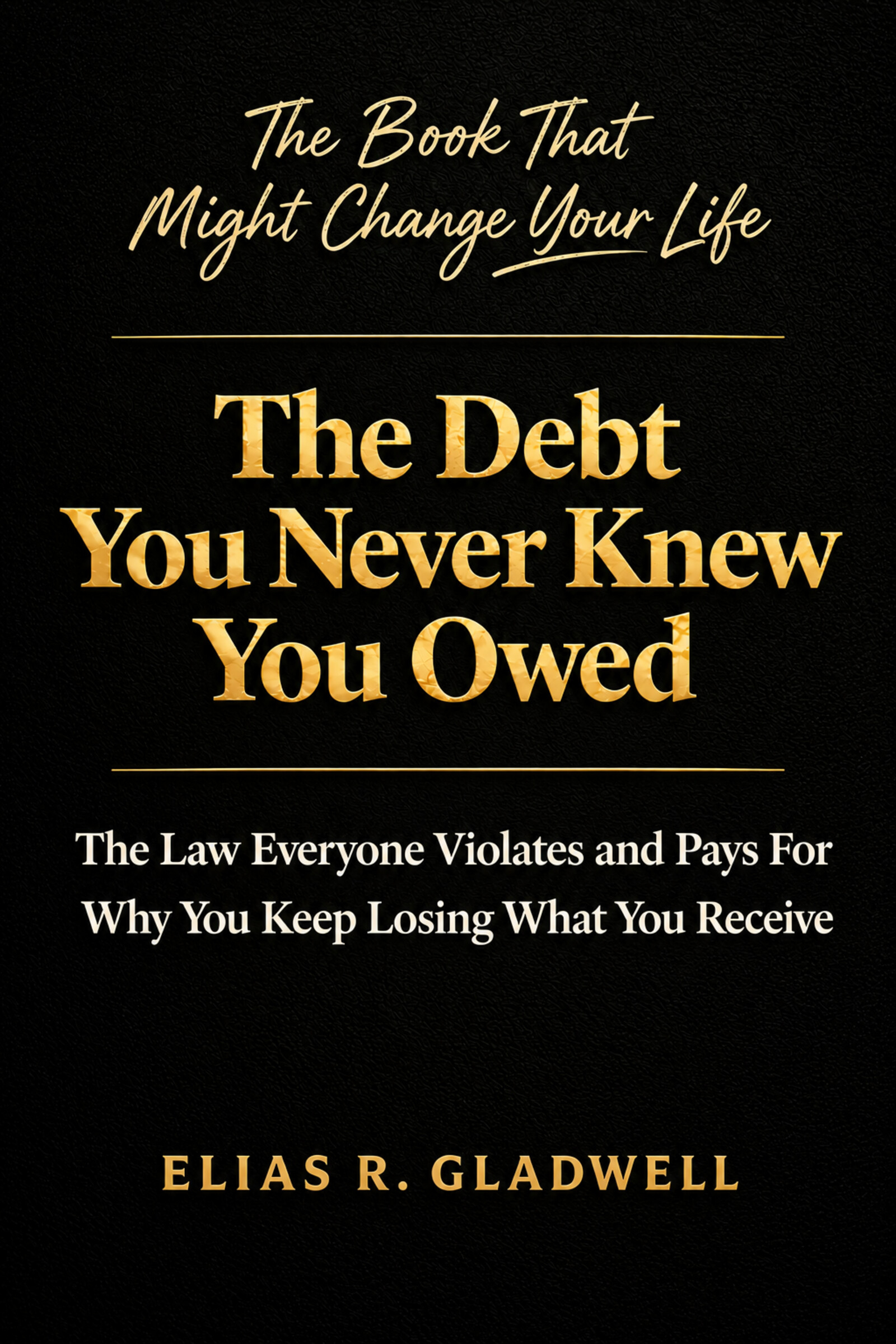
The Debt You Never Knew You Owed argues that nothing is ever really free — that giving and receiving run on an unspoken contract most people never learn to read, and that unacknowledged exchange is what quietly drains marriages, friendships, and careers long after the original gift or favor is forgotten. Drawing on research from Marcel Mauss's study of gift economies to Malinowski's Kula ring to modern social psychology, Elias R. Gladwell traces how invisible debt builds, and why it so often collapses relationships that looked fine from the outside.
The book moves from diagnosing the pattern to living without creating more of it — when not to give, how to receive without taking too much, and how to close old accounts cleanly, without a dramatic confession or an elaborate repayment.
Readers who sense that a relationship, a job, or a friendship cost them more than anyone ever named out loud, and want language for the quiet imbalance between what they gave and what they got back.