I grew up in Eastern Europe under socialism. Not the socialism of American bumper stickers or college syllabi. The real thing — the gray one, with the ration cards and the waiting lines and the secret police and the apartments assigned by committee. I know what it looks like when a government controls everything and delivers very little. I also know what it looks like when stability works, when people are safe walking home at night, when children go to school on merit and not on money. I watched the Wall come down the same week I graduated from university, and I spent the next decade helping to build capitalism from nothing — learning what markets can do and what they destroy and how quickly a society changes when incentives shift.
I came to New York eventually, the way everyone does — certain it was the greatest city in the world and determined to prove it. I built businesses here. I raised a family here. I watched the city spend billions on problems it had every reason and resource to solve, and then watched it explain, over and over, why those problems simply couldn’t be solved. I watched compassion become an industry. I watched dysfunction get renamed as equity. I watched a city that genuinely wants to do good discover that doing good is less profitable than managing the need to do it.
This book is what I found when I stopped accepting the explanations.
I am not a politician and I am not trying to become one. I am not a think-tank economist or an academic with a theory to protect. I am someone who has lived under two systems and can describe the difference plainly. That is the only credential this book claims — and it is the only one relevant to what follows.
There is a building on the west side of Manhattan I pass regularly. It has been wrapped in scaffolding for four years. The scaffolding went up for a facade inspection. The inspection found violations. The violations generated paperwork. The paperwork entered a queue. The queue fed a process. The process is still in progress. Every month the scaffolding stays up, someone gets paid to maintain it. By now the cost of maintaining the scaffolding has probably exceeded the cost of fixing what it was built to inspect.
Nobody is angry about this. Nobody is embarrassed. The scaffolding belongs to no particular story — it is simply part of the texture of New York, the way that potholes repaired in spring return by November, the way that the same subway station under renovation for seven years has not yet produced a functioning elevator. The city is very busy. The city has many needs. The city is doing its best.
I do not believe it is doing its best. I think it has learned that doing its best is unnecessary.
New York is not a failing city. It is something more troubling — a city that has figured out how to profit from the appearance of trying while avoiding the inconvenience of succeeding. The homeless population is managed, not housed. The affordable housing shortage is acknowledged, not corrected. The school achievement gap is studied, funded, and renamed, but not closed. The subway is modernized on presentation slides while the actual trains run on signals designed in the 1930s. The same crises reappear in each mayoral campaign, each budget cycle, each press conference announcing a new initiative. And the money continues to flow — enormous amounts of money, more per capita than almost any comparable city in the world — into systems that have quietly organized themselves around the perpetuation of the problems they were created to solve.
This is what managed failure looks like.
It does not look like corruption, at least not the straightforward kind. No one is taking envelopes of cash in parking garages. What is happening is both more ordinary and more corrosive: systems have been designed, gradually and without any single moment of decision, to reward their own continuation rather than their own success. A shelter that solves homelessness loses its budget justification. A housing program that produces true affordability at scale eliminates the political leverage that comes from scarcity. A school that closes the achievement gap removes the rationale for the consultants, the initiatives, the grant applications. When the problems go away, so does the money. And the money is very good.
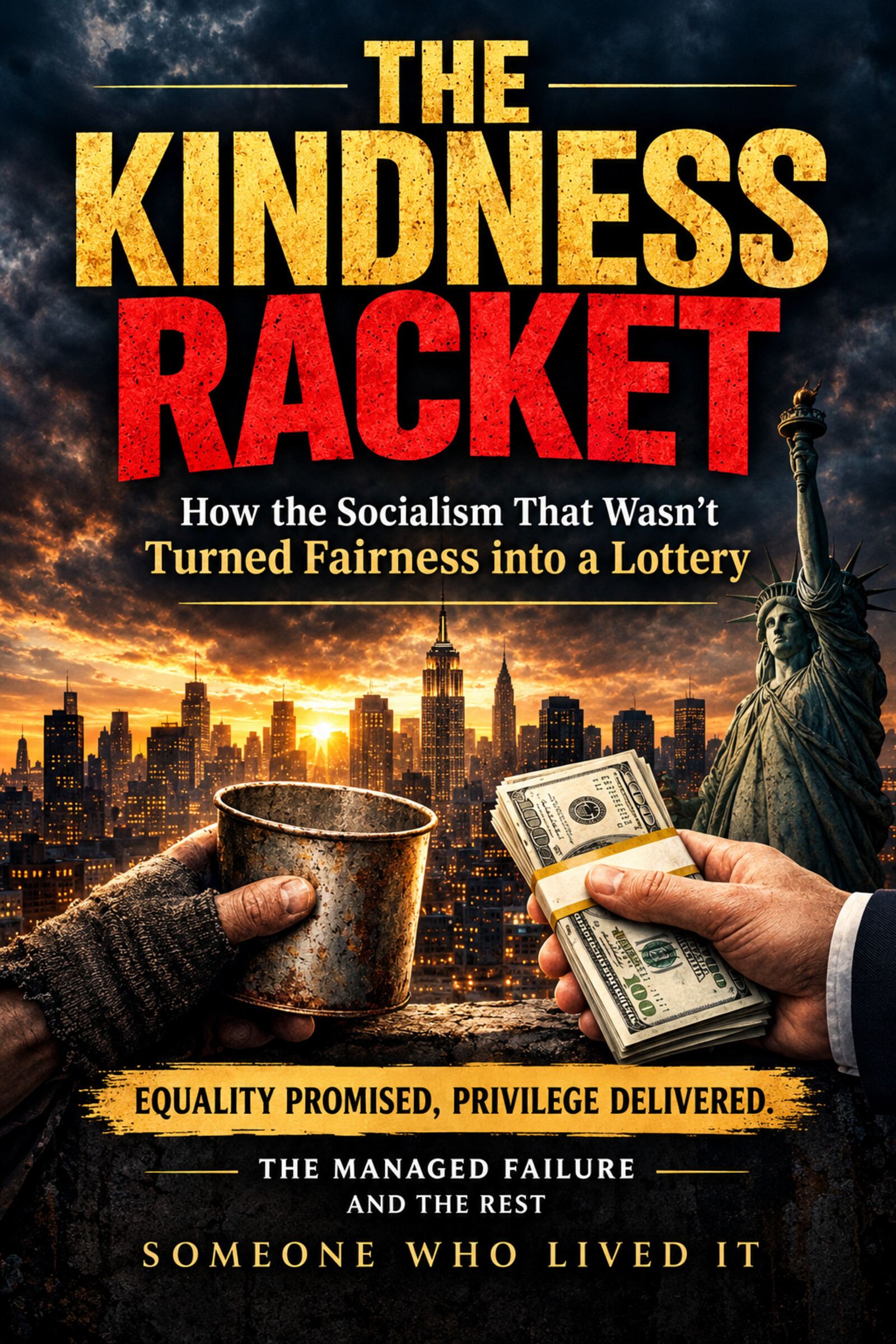
The Kindness Racket argues that New York isn't a failing city so much as one that has learned to profit from the appearance of trying — homelessness managed instead of solved, an affordable housing shortage acknowledged rather than corrected, an achievement gap studied and renamed but never closed. Writing under a pseudonym, the author draws on a childhood under Eastern European socialism and a life since built in New York to trace how systems quietly reorganize themselves around their own survival rather than their own success.
Built around six arguments and worked out with arithmetic and specific examples rather than slogans, the book makes its case as someone who has actually lived under the system New York's political class invokes most often to justify itself — and who is in a position to say plainly where the comparison holds and where it doesn't.
Readers interested in how good intentions and real money can still produce a city that manages its problems instead of solving them, told from a firsthand, cross-system perspective.