I didn’t set out to write a book about obsession. I set out to understand something smaller: why a man you barely knew can take up more room in your head than a man you loved for years.
The answer, as far as I can tell, has less to do with the man than with the conditions he creates. I’ve spent a long time with this question, in my own relationships, in the research on attachment and desire, and in conversations with people who couldn’t stop thinking about someone who had long since stopped thinking about them. The same patterns kept turning up. I’m not immune to any of them, and I won’t pretend otherwise. Understanding how something works doesn’t release you from it. What it can do is make you a more honest witness to your own life while you’re still in the middle of it.
That’s what I hope this book offers. You won’t find a cure in it, or rules for winning anyone back. What you’ll find is a description of what tends to happen when you fall for someone who won’t fully show up, written by someone who has been on both sides of it.
The women in these pages are composites, put together from many stories, with names and details changed. The patterns are real. Where I refer to research, it’s to studies you can look up yourself, and I’ve tried not to make them say more than they do.
If you recognize yourself here, that’s the point. Seeing it clearly won’t stop you from feeling it. But it may change what you do next.
Most women can name two kinds of men from their own past. The first answered texts promptly, made plans and kept them, said what he felt and meant it. You probably remember him fondly, if you remember him at all. Friends called him sweet. The second was harder to pin down. He’d be warm one evening and silent for four days afterward. He told you very little about himself, and what he did tell you seemed to carry enormous weight. When he left early without saying why, you spent the drive home wondering what you’d done. You remember him in detail. You may still be able to quote things he said.
Nobody likes to admit this pattern, because it seems to say something unflattering about the person who falls into it. It sounds as if women want to be treated badly. They don’t. What’s actually happening is more mechanical than that, and much less personal. The mind gives weight to whatever makes it work, and the second man makes it work very hard.
Think about how attention behaves. When something is simple and resolved, you process it quickly and move on. When something is unresolved, your mind keeps returning to it. In the 1920s the psychologist Bluma Zeigarnik noticed that waiters in a Berlin restaurant could remember complicated unpaid orders perfectly and then forget them almost as soon as the bill was settled. In experiments she found that people recalled interrupted tasks better than completed ones. An open loop stays open in the mind. A man who never quite finishes a sentence, a plan, a feeling, is an open loop you carry around all day.
So the first man fades. He was kind, he was clear, and there was nothing left to figure out. The second one takes up residence. You replay conversations. You read his messages for tone. You notice that he used your name once and wonder whether it meant something. All that work produces a feeling of investment, and investment feels a great deal like love. After a few weeks you’ve thought about him for more hours than you’ve actually spent with him, and those hours are real to you, even though he wasn’t there for any of them.
In 2011 three researchers at the University of Virginia and Harvard, Erin Whitchurch, Timothy Wilson and Daniel Gilbert, ran a study that captures this almost perfectly. Women students were shown Facebook profiles of male students and told that these men had looked at their profiles too. Some were told the men had rated them highly. Some were told the men had rated them about average. A third group was told only that the men might have liked them a lot or only a little: they couldn’t be told which. The women in that third group, the uncertain group, ended up most attracted to the men, and they reported thinking about them the most. Not knowing kept the men on their minds, and being on their minds made them more attractive. The men themselves had done nothing at all.
That’s the uncomfortable center of this whole book. A great deal of what feels like attraction to an unavailable man is produced by the uncertainty around him, not by him. He doesn’t have to be especially handsome, or clever, or kind. He only has to leave enough unanswered to keep your mind busy.
Most of these men aren’t plotting anything. Some are guarded because they’ve been hurt. Some are distracted, or self-absorbed, or not that interested and unwilling to say so. A few are deliberate, and enjoy being chased. But the effect doesn’t depend on intention. Absence does its work whether anyone means it to or not.
Meanwhile the man who showed up loses ground through no fault of his own. When someone is fully available, there’s nothing for your imagination to do. You know where you stand with him, so you put him in a category, and categories are easy to file away. It’s one of the small injustices of human psychology that generosity, offered freely and early, can make a person seem less interesting than someone who offers almost nothing.
Here’s how it played out for a woman I’ll call Claire. She met him at a conference in Chicago. He wasn’t the most impressive man there, but he was the least readable. He listened closely, said little, and left the dinner before dessert without telling anyone why. On the drive home she replayed their conversation. What had he meant by that pause? Why had he looked at her like that and then looked away?
For the next three weeks she thought about him more than she thought about the man she’d been seeing for six months, a steady, funny architect who cooked for her on Sundays. That relationship was easy and kind and, in her imagination, going nowhere. When she ran into the conference man again at a work event, he was warm for an hour, distant for the rest of the night, then briefly warm again as he said goodbye. She told a friend afterward that there was something there. She could feel it.
What she was feeling was real enough. It just wasn’t connection. Her mind was trying to solve a puzzle it had been handed, and a puzzle is more gripping than an answer. Claire’s story began the way most of these stories begin: no cruelty, no plan, only a gap that her imagination walked into and couldn’t find its way out of.
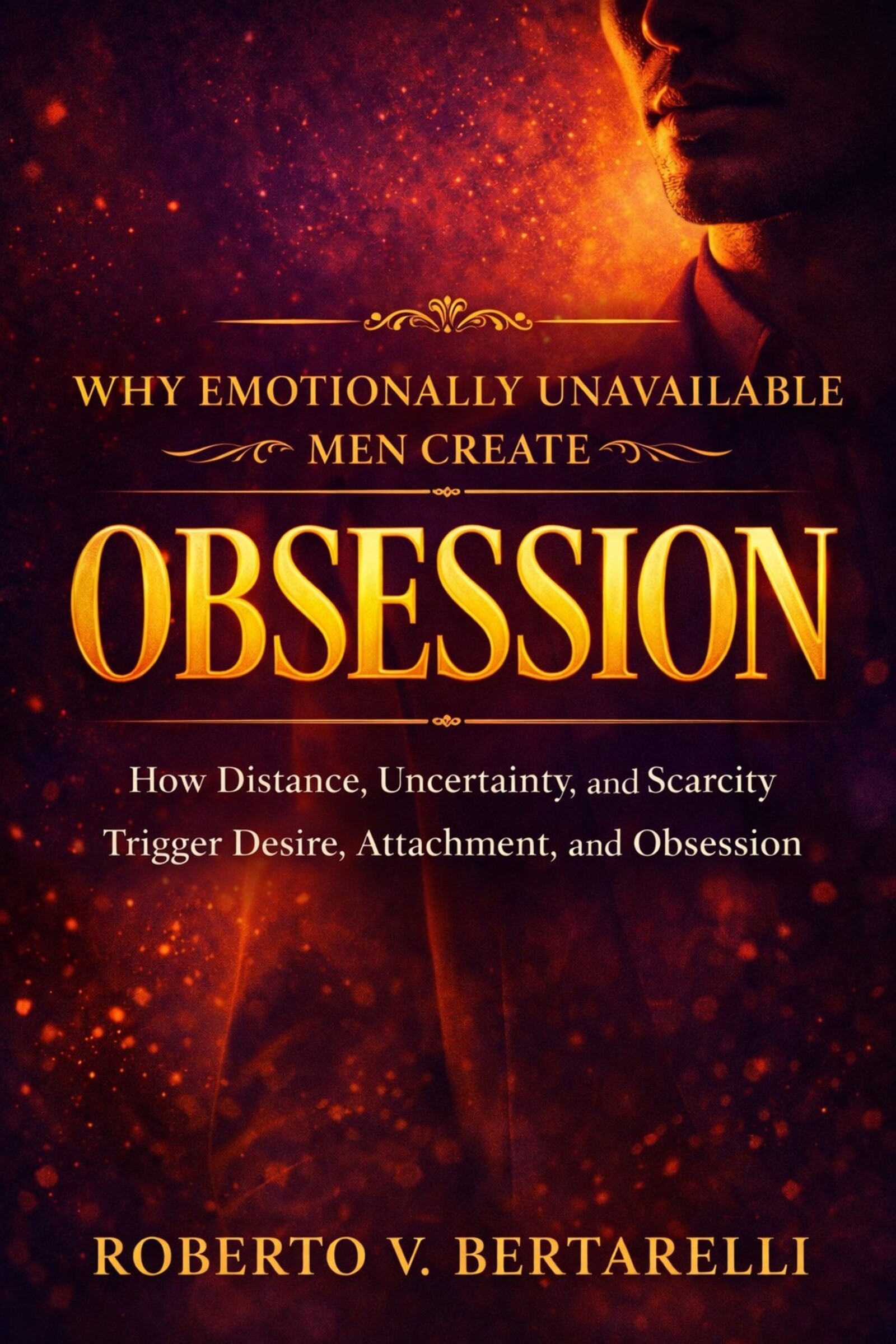
Why Emotionally Unavailable Men Create Obsession explains why the man who gives the least so often gets wanted the most — not because of anything admirable in him, but because uncertainty keeps the mind working in a way consistency never does. Drawing on attachment research and composite case stories, Roberto V. Bertarelli traces how distance, inconsistency, and the ‘almost’ of a near-miss relationship manufacture a preoccupation that feels like love but runs on an entirely different mechanism.
The book moves through attraction, the withholding loop, and the slow replacement of hope for connection, ending with what real, available desire actually feels like by comparison. There are no rules for winning anyone back here — only a clear map of the pattern, so it's easier to recognize before it takes hold again.
Readers who've found themselves more consumed by someone distant or inconsistent than by someone who was actually good to them, and want to understand the psychological mechanics behind why that happens.